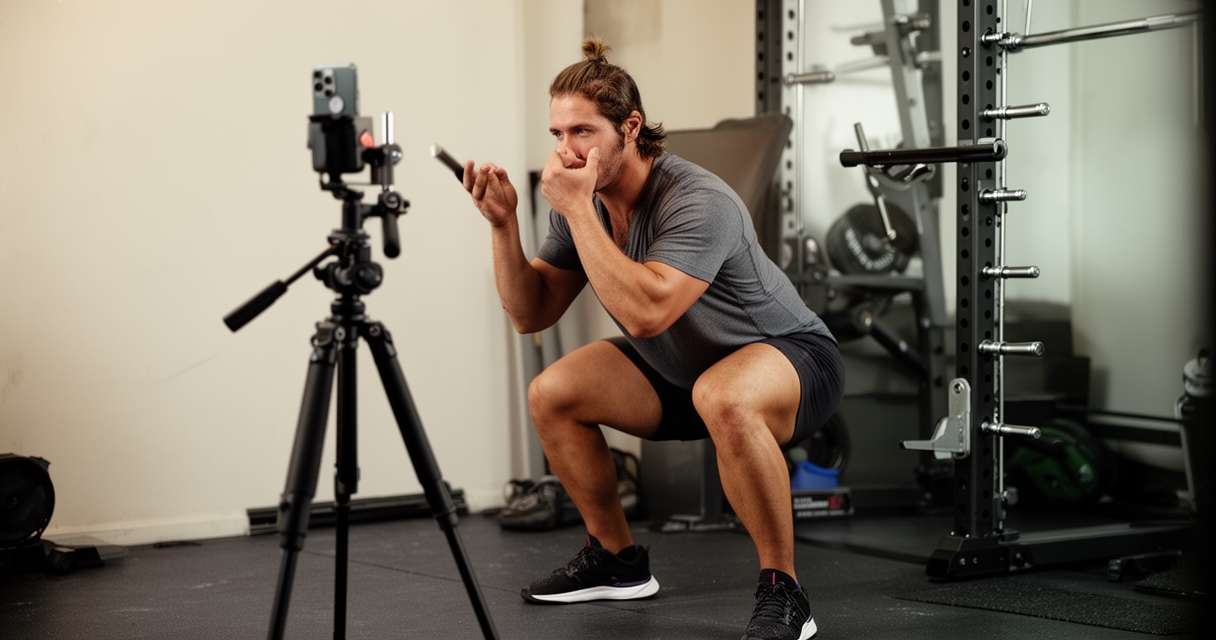
A missed rep doesn’t wait for a phone to process video. By the time an app flags a form fault on rep 8, rep 9 is already loaded — and if that’s the one where a shoulder gives out or a knee caves past the point of no return, no camera on a tripod is going to catch 225 pounds.
That’s the tension behind the current wave of AI form-check apps — Gymscore, CueForm AI, FormCheck AI, AiKYNETIX, and a handful of others pitching themselves as the best AI form check apps for lifting without a spotter. Solo lifters — the ones without a training partner, without a coach, without a rack that has spotter arms — are the target market, and the pitch is seductive: point a phone at the bar, get real-time coaching on depth, bar path, and knee tracking.
Quick answer: these apps are a genuinely useful second pair of eyes for technique work and moderate-load training. None of them can physically catch a bar, none has published evidence that they predict a failed rep before it happens, and camera angle affects accuracy more than which app gets downloaded. Treat them as a coaching supplement, not a spotter replacement.
The rest of this breaks down what the research actually shows, how the leading apps compare, and where the real safety line sits.
What “AI Form Check” Apps for Lifting Without a Spotter Actually Do (and Don’t)
Every app in this category runs on the same underlying technology: markerless pose estimation. A phone camera tracks roughly 17 skeletal keypoints — shoulders, hips, knees, ankles, wrists — and the software estimates joint angles frame by frame. That’s the entire mechanism.
“AI-powered form analysis” is marketing language for pose estimation plus a rules engine. The apps aren’t measuring muscle activation, bar velocity loss under load, or how close a lifter is to true failure. They’re measuring where joints are in space, then comparing that against a template of what a “good” rep should look like.
That distinction matters because the underlying accuracy of pose estimation for fitness is still an open research question. A 2025 systematic review in Frontiers in Sports and Active Living examined camera-based movement-screening apps and concluded their accuracy “remains to be thoroughly evaluated” against gold-standard motion capture, and that real-time feedback and correction quality is inconsistent across apps. This isn’t a fringe finding — it’s the current state of the peer-reviewed literature on the entire category, not a knock on any one product.
Compare that to what AI personal trainer apps generally promise — programming, progression, and coaching cues — and form-check apps are a narrower, more specific tool. They’re built to answer one question: does this rep look structurally sound? Not: is this lifter about to get hurt?
Gymscore vs CueForm AI vs FormCheck AI (and the Rest) — Compared
The field has split into a few distinct approaches. Some apps chase breadth — as many exercises as possible. Others narrow in on the three or four lifts where form actually matters most for injury risk: squat, bench, deadlift.
| App | Lifts Covered | Pricing | Standout Feature | Biggest Limitation |
|---|---|---|---|---|
| Gymscore | ~2,500+ exercises | Free tier; paid tier for full features | 5-dimension 0-100 score (bracing, posture, foot placement, ROM, efficiency) + AI coach chat | Play Store reviewers report the app crashing or hanging on video upload |
| CueForm AI | Squat, bench, deadlift only | Free tier; about $10/month | Narrow focus with conversational coaching built around the big three lifts | Doesn’t cover accessory work or bodyweight movements |
| FormCheck AI | 30+ exercises | About $12-13/month or about $90/year | Motion tracking plus built-in “safety alerts" | "Safety alerts” are still pose-based pattern flags, not a physical intervention |
| AiKYNETIX | Squat, deadlift, Olympic lifts, bench | About $12.99/month | 3D motion tracking with lift-velocity analysis | Advertises about 95% accuracy and university biomechanics-lab validation — a vendor claim, not an independently published study |
Gymscore’s breadth is the widest in the category by a large margin, and the five-dimension scoring system is more granular than most competitors. But breadth comes with a real cost: multiple Android reviewers on the Google Play Store report the app crashing on video upload — one wrote that it “hangs or shuts down as soon as I upload any video,” and another said flatly the app “crashes every time you try to load a video.” A form-check app that can’t reliably process video is not a form-check app.
CueForm AI takes the opposite bet — cover fewer lifts, cover them well. For a lifter training only the big three, that narrower scope removes a lot of the noise that comes with a 2,500-exercise library.
AiKYNETIX’s marketing is worth flagging directly: the company advertises about 95% accuracy and cites university biomechanics-lab validation. That number is self-reported on the vendor’s own site — there is no independently published, peer-reviewed study behind it in the research examined for this article. It may be accurate. It has not been verified by anyone outside the company selling the product. Every pricing and feature claim across this table comes from vendor marketing pages, checked in 2026 — none of these apps has been evaluated by an independent testing authority, so the comparison reflects what each company says about itself.
It’s also worth separating this category from workout logging apps like Hevy or Strong, which track sets, reps, and load over time but do zero form analysis. Logging apps answer “did the workout happen and how much weight moved.” Form-check apps attempt to answer “did it look safe while it happened.” They’re not competitors — most serious lifters will eventually run both.
What These Apps Reliably Catch
Pose estimation is genuinely good at spotting gross, visible faults — the kind a training partner would call out from across the gym. Squat depth cutting short of parallel. A bar drifting forward off the hips during a deadlift pull. A knee caving inward under load. A bench press where one shoulder rises faster than the other. Rep count and tempo tracking are also reliable, since those are simple positional and timing measurements, not subtle judgment calls.
Camera placement, however, matters more than which app is running. A 2026 study in JMIR mHealth and uHealth tested squat-detection accuracy across different camera configurations and found the range was enormous: 0% detection from a side view at 90 centimeters, up to 95.5% from a diagonal angle around 45 degrees at 200 centimeters (roughly 6 to 7 feet away). Mean detection rates across all tested configurations landed around 61.5% for squats and 61.1% for push-ups.
That’s not a small variance — it’s the difference between an app that’s nearly useless and one that’s genuinely reliable, based entirely on where the phone is standing. A lifter propping a phone against a plate at a bad angle is running a fundamentally different experiment than one who’s set up a diagonal shot at proper distance, regardless of which app is open.
On the underlying joint-angle math: a 2024 Heliyon study comparing markerless pose estimation against Vicon motion-capture systems (the clinical gold standard) found root-mean-square error under about 10 degrees for most joints, climbing to as much as 15 degrees at the shoulder and ASIS (hip) landmarks. That’s precise enough to flag an obviously collapsed knee or a badly rounded back. It is not precise enough for clinical-grade measurement, and none of these consumer apps claim to be a diagnostic tool.
What They Cannot Catch — And Why That Matters at Failure
Everything above describes position. None of it describes effort, and that gap is where the real risk sits.
An AI form-check app has no way to sense bar-speed loss under the bar, no way to feel a brace weakening mid-rep, and no way to distinguish a lifter who’s grinding through a tough set from a lifter two reps from a genuine miss. A spotter reads those cues constantly — the bar slowing, the sound of a strained breath, the tremor in a lockout — and none of it shows up in skeletal keypoints on a screen.
More importantly, none of it matters if the rep actually fails, because the app cannot physically intervene. A spotter’s entire job is contact: hands on the bar, a shoulder under it, a body positioned to take weight off a lifter who can’t finish the rep. A phone on a tripod has no hands. If a squat buries someone at the bottom, or a bench press stalls three inches off the chest, the app will accurately record what happened. It will not stop it from happening.
There is also no published, validated research — in the sources reviewed for this article or elsewhere in the current literature — showing that any of these apps can predict an impending failed rep before it occurs. The Frontiers 2025 review’s conclusion that real-time correction quality “remains to be thoroughly evaluated” applies directly here: the category hasn’t been proven to prevent injury, only to flag faults after the fact.
This is exactly the gap that dedicated prehab and injury-prevention apps are built to address from a different angle — mobility, movement screening, and injury-risk patterns over time, rather than in-the-moment failure detection. And it’s a useful contrast against AI programming apps like JuggernautAI, which have a much more established use case: autoregulating training load and volume based on performance data. Programming AI has a track record of doing what it claims. Failure-prediction AI, in this category, does not yet.
Is It Actually Safe to Train Alone With the Best AI Form Check Apps?
The honest answer splits by load, not by app quality.
For technique work, warm-up sets, and moderate-intensity training in the RPE 6-8 range, an AI form-check app is a legitimate substitute for a training partner’s eyes. Catching a creeping knee valgus on set two of five is exactly the kind of gross fault these tools are built to flag, and doing that consistently over weeks is more coaching value than most lifters get training alone with no feedback at all.
For a near-max squat attempt, or true failure-training on a free bench press with nobody in the room, an app is not an adequate safety plan. Nothing reviewed here claims to be, despite marketing copy that leans hard on words like “spotter” and “safety alerts.” A safety alert that fires after a knee has already caved is a coaching note, not an intervention.
The actual safety plan for solo training is physical, not digital: rack pins or safety-bar catches set at the right height for every heavy squat, a cap at RPE 8 on unracked bench work done alone, and a Smith machine or safety-bar setup for anyone bench pressing without a spotter at all. An AI form-check app layers on top of that as a between-session coaching supplement — reviewing yesterday’s squat video, tightening bar path over a training block — not as the thing standing between a lifter and a buried rep.
FAQ
Can an AI form-check app replace a spotter for heavy lifts?
No. These apps analyze camera video for positional faults; they have no physical mechanism to catch a bar or assist a failed rep. For near-max squats or bench press, physical safeties — rack pins, safety bars, or an actual human spotter — remain necessary.
How accurate are these apps, and does camera angle matter?
Accuracy varies enormously by setup. A 2026 JMIR mHealth study found squat-detection rates ranging from 0% at a poor side angle to 95.5% at a diagonal angle around 6-7 feet away, with camera placement mattering more than the specific app used.
Which app covers compound lifts most reliably?
CueForm AI and AiKYNETIX both focus narrowly on squat, bench, and deadlift (AiKYNETIX adds Olympic lifts), which trades breadth for depth on the lifts where form errors carry the most injury risk. Gymscore covers far more exercises but has documented video-upload reliability issues.
What do these apps reliably catch versus miss?
They reliably catch visible positional faults — shallow squat depth, a drifting bar path, knee valgus, uneven bar tilt on bench press. They cannot detect bar-speed loss, weakening brace, or genuine proximity to failure, since none of that is visible from joint-position data alone.
Is it safe to train to failure alone using just an AI form checker?
Not for heavy compound lifts. RPE 6-8 technique work is reasonable to do solo with app feedback. True failure training on a free bench or a heavy squat needs physical safety equipment — rack pins or safety bars — regardless of what software is running.
The Verdict on Training Alone
AI form-check apps earn a place in a solo lifter’s routine as a technique tool, not as a safety system. Gymscore’s breadth and CueForm AI’s focus both work for catching gross faults on moderate loads; AiKYNETIX’s accuracy claims deserve skepticism until an independent lab, not the company itself, publishes the number.
The practical move: set the camera at a diagonal angle roughly 6-7 feet out — not side-on, not too close — and build a physical safety net for anything approaching a max: rack pins set at the failure point, a cap at RPE 8 for unspotted bench work, no true-failure sets alone on a free barbell.
The app can tell you your knees caved on rep 8. It can’t stop the bar on rep 9.
References
- El-Rajab et al., “Camera-based mobile applications for movement screening in healthy adults: a systematic review,” Frontiers in Sports and Active Living, 2025 — https://doi.org/10.3389/fspor.2025.1531050
- Oliosi et al., “Evaluation of Smartphone Camera Positioning on AI Pose Estimation Accuracy for Exercise Detection: Observational Study,” JMIR mHealth and uHealth, 2026;14:e82412 — https://mhealth.jmir.org/2026/1/e82412
- Mercadal-Baudart et al., “Exercise quantification from single camera view markerless 3D pose estimation,” Heliyon, 2024 — markerless pose-estimation joint-angle validation against Vicon motion capture.
- Gymscore — Google Play Store app listing and user reviews, accessed 2026.
- AiKYNETIX — official website and pricing page; accuracy and biomechanics-lab validation claims are vendor self-reported, not independently published.